Localization in Spatiotemporal Fields via Environmental PDEs

1Institute of Environment, Florida International University 2Department of Computer Science, The University of New Orleans
Overview diagram of the localization framework

We localize GPS-denied vehicles by matching onboard sensor readings against spatiotemporal fields predicted by environmental PDEs — no satellite navigation required.

Abstract

This paper proposes a localization framework that uses spatiotemporal fields governed by partial differential equations (PDEs) as localization signatures. Two PDE classes are considered: the shallow water equations, which describe free-surface flows in coastal and riverine environments, and the advection-diffusion equation, which models the transport and mixing of scalar quantities such as temperature, salinity, and dissolved oxygen.

A numerical PDE solver provides predicted fields over the domain, and multiple field channels are fused as multimodal measurements to improve localization accuracy. We formulate the problem within a Rao-Blackwellized particle filter (RBPF) that partitions the vehicle state into a nonlinear component sampled by particles and a linear sensor bias component tracked analytically via per-particle Kalman filters. This factorization reduces the required number of particles compared to a standard particle filter while accounting for realistic sensor drift.

Simulation studies on both PDE scenarios show that the RBPF consistently outperforms a standard particle filter in terms of final position error and RMSE across varying particle counts. Field experiments with an autonomous surface vehicle measuring salinity, temperature, and dissolved oxygen validate that PDE-governed environmental fields provide sufficient spatial variability for practical localization.
Method

System Overview

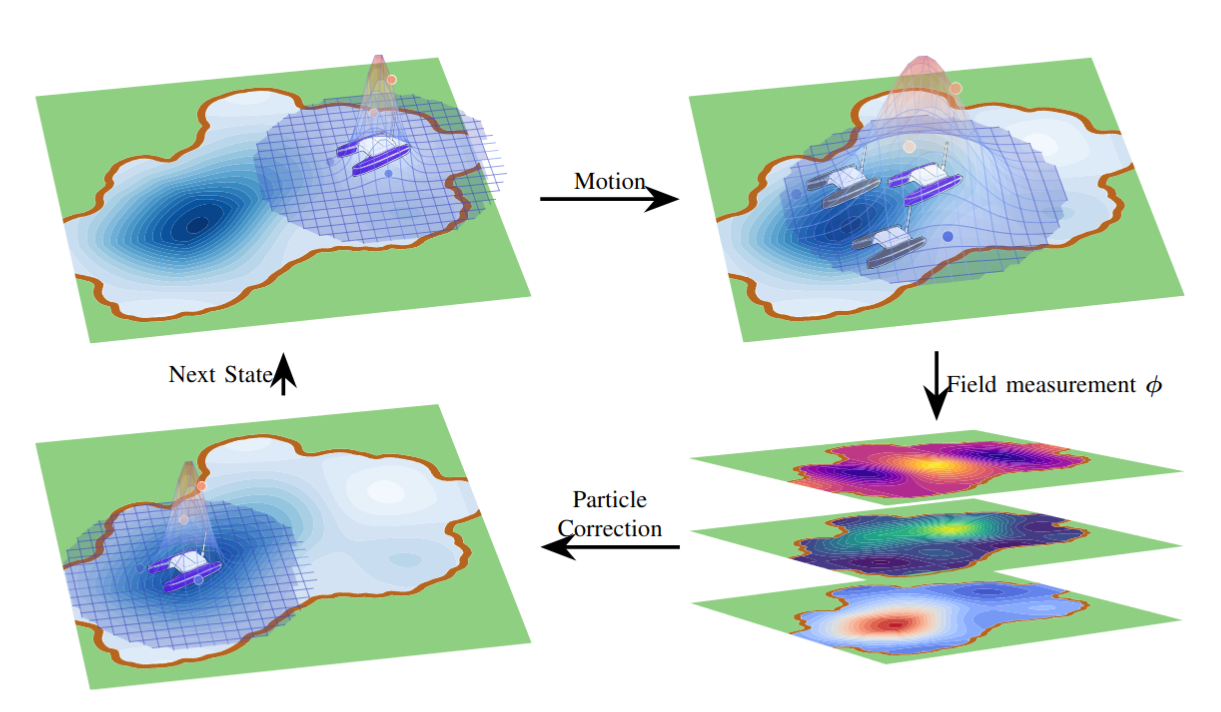
The vehicle navigates a two-dimensional domain characterized by M environmental scalar and vector fields governed by PDEs. Onboard sensors measure local field values, which are compared against PDE-predicted fields to update a recursive Bayesian estimator. The vehicle state is partitioned into a nonlinear pose component (position, heading, speed) sampled by particles, and a linear per-channel sensor bias component updated analytically by a Kalman filter attached to each particle.


Shallow Water Equations (SWE)

The SWE model free-surface flows in coastal and riverine environments where the horizontal scale is much larger than the depth. The conserved variables are water height η and its momentum ηv. This yields M = 3 sensing channels: water height, and horizontal velocity components u and v.

Advection-Diffusion Equation

The advection-diffusion equation models the transport and mixing of scalar properties such as temperature, salinity, dissolved oxygen, and chemical concentration. Multiple coupled scalar fields governed by the same velocity field are vectorized into a multimodal measurement vector.

Rao-Blackwellized Particle Filter (RBPF)

Unlike a standard particle filter that samples the full state, the RBPF exploits the conditional independence structure of the PDE measurement model. The full state is partitioned into:

  • Nonlinear component xn = [px, py, θ, v] — the vehicle pose and speed, sampled by particles.
  • Linear component xl = [δϕ1, …, δϕM] — per-channel sensor biases, tracked analytically by a Kalman filter conditioned on each particle.

This factorization dramatically reduces the required particle count compared to a standard PF while correctly accounting for realistic sensor drift.

Simulation Results

Scenario 1: Coastal Wave Propagation (SWE)

A vehicle navigates a 2D domain with SWE-driven fields. The RBPF is initialized with a uniform prior and converges to the true position significantly faster and with lower final error than the standard particle filter, across varying particle counts.


Scenario 2: Water Quality Modeling (Advection-Diffusion)

A vehicle navigates a domain with coupled scalar fields (temperature, salinity, dissolved oxygen) governed by the advection-diffusion equation. Fusing multiple channels as multimodal measurements further improves localization accuracy. The RBPF again consistently outperforms the standard PF on final position error and RMSE.

Quantitative Results

M SWE Advection-Diffusion
RMSE (m) Final Error (m) RMSE (m) Final Error (m)
1 1.59 ± 0.55 1.35 ± 0.49 2.63 ± 1.64 2.11 ± 0.13
2 0.94 ± 0.10 0.90 ± 0.26 2.27 ± 1.21 1.61 ± 0.39
3 0.82 ± 0.06 0.69 ± 0.08 1.51 ± 0.79 1.62 ± 0.64

Table 1: Performance Comparison of SWE and Advection-Diffusion Models across varying Feature Counts (M).

PF vs RBPF Comparison Across Particle Counts

Figure: Comparison of PF (Blue) and RBPF (Orange) localisation accuracy on the shallow-water estimation (SWE) task across five independent runs for varying numbers of particles. Both metrics decrease as particle count increases, with RBPF consistently outperforming PF at equivalent sample sizes.

Field Experiments

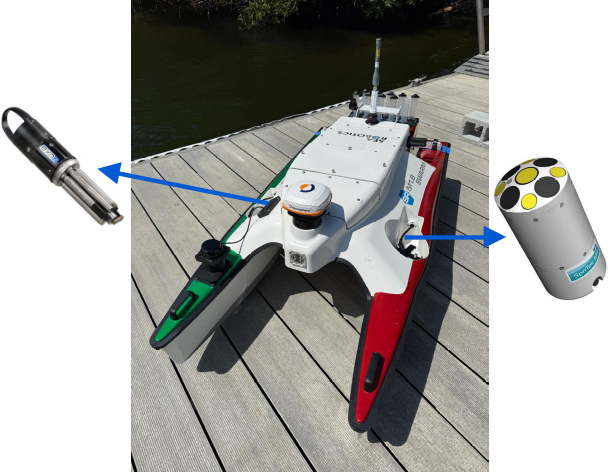
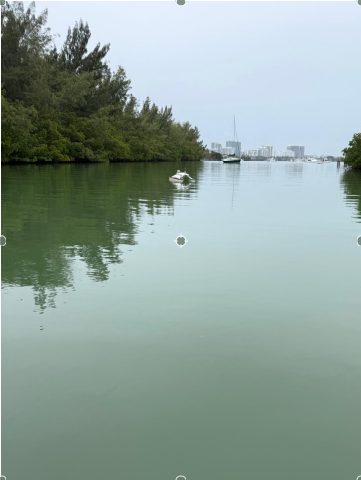
We validate our approach with an autonomous surface vehicle (ASV) equipped with sensors measuring salinity, temperature, and dissolved oxygen. The experiments demonstrate that PDE-governed environmental fields provide sufficient spatial variability for practical GPS-denied localization in real-world conditions.

Autonomous Surface Vehicle Platform

ASV platform side view

ASV SeaRobotics Surveyor, left YSI EXO2, right ADCP

ASV platform in mission

ASV in Mission


Localization Results

The RBPF successfully localizes the ASV using the PDE-predicted multimodal field (salinity, temperature, dissolved oxygen) as a reference. The estimated trajectory converges to the GPS ground-truth trajectory, validating the effectiveness of the approach in real environmental conditions.

BibTeX

@inproceedings{Fuentes2026localization,
  author    = {Fuentes, Jose and Newaz, Abdullah Al Redwan and Cavalcanti, Ana and Bobadilla, Leonardo},
  title     = {Localization in Spatiotemporal Fields via Environmental {PDEs}},
  booktitle = {Proceedings of the IEEE/RSJ International Conference on Intelligent Robots and Systems (IROS)},
  year      = {2026},
}